From Sundial to Electric Winder: A Timeline of Tower Timekeeping

Stand in a square as the hour strikes and you are hearing the end of a very long argument about how to measure time. For most of history, the clock in the tower was the only clock many people had. It told them when the market opened, when to be at prayer, when the gates would close. That responsibility shaped the machinery: big enough to be seen, heavy enough to survive weather, and reliable enough that nobody had to guess.
The story of tower timekeeping is not a tidy march of inventions replacing one another. It is a series of layers, and most towers still contain several of them at once — an old wheel train, a nineteenth-century dial, a twentieth-century winding motor, a twenty-first-century sensor in the corner. Knowing which layer does what is the beginning of caring for any of them.
Sun, Shadow, and the Noon Line
Before anything ticked, public time came from the sun. A sundial cut into a church wall told the hour to anyone standing in the square, and the tower itself was often the instrument: a high point makes a long shadow, and a long shadow resolves minutes that a small dial could never show.
Inside the great churches, that idea grew into something close to a scientific instrument. A small hole was cut high in the roof or wall, and a meridian line was inlaid across the floor. As the sun crossed, a disc of light travelled along the line, marking solar noon and the slow drift of the seasons. These were not decorations. They were reference points, and people argued about them.
Sunlight had an obvious limit. When it failed, the bell took over: the curfew, the watchman's call, the bell that sent workers home. For centuries the tower's real function was not to display the time but to broadcast it, and the broadcast was audible.
Weights, Escapements, and a Room Full of Iron
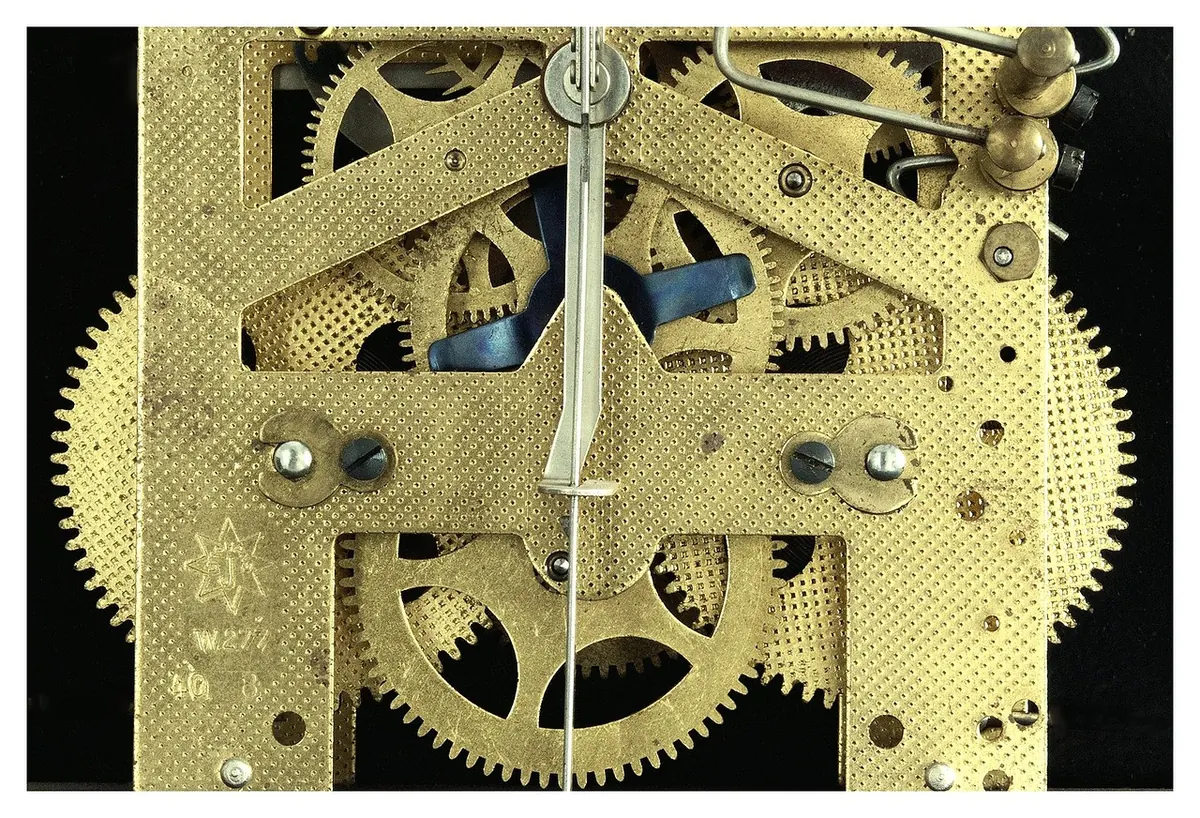
Mechanical clocks appear in Europe in the late thirteenth century, and within a few generations they had climbed into towers. The principle was simple and stubborn: a weight on a rope turns a drum, an escapement releases that fall one tick at a time, and a train of wheels divides the fall into the motion of hands.
Tower clocks are heavy engineering. Weights were often stone or lead, sometimes several hundred kilograms, descending through a shaft or a corner of the tower. Striking usually had its own train — its own weight, its own wheels, its own spinning fly to govern the bell hammer — so that the clock could keep time while it was busy announcing it. The result was a room full of iron, with ladders, pulleys, hatches and a permanent smell of oil and dust.
The oldest survivors, such as the celebrated clock at Salisbury Cathedral, are often described as among the earliest working machines of any kind. Their timekeeping was poor by modern standards: the early verge escapement with a foliot balance had no natural period to keep, so a cold night or a stiff bearing could pull it minutes off. Nobody minded much. The bell was calling people, not timing a race.
The Pendulum and the Minute Hand
Christiaan Huygens applied the pendulum to clocks in 1656, and the effect on tower horology was structural. A pendulum has a period set by its length, so it resists being hurried. In towers this meant long pendulums — a seconds pendulum is roughly a metre, and some tower clocks use a two-second beat with a rod around four metres long.
The anchor escapement, credited to Robert Hooke and applied in English practice by Thomas Tompion, allowed a pendulum to swing in a small arc with less disturbance to the train. Better timekeeping changed the outside of the building too: minute hands began to appear on public dials, because there was now something worth pointing at.
Wind is the quiet adversary of every large dial. A gust on a square metre of hand and dial pushes back through the train; in an ordinary escapement, the pendulum feels it. The gravity escapement designed for the Great Clock of Westminster — Big Ben — was widely admired and widely copied because it isolates the pendulum from the hands almost entirely, letting a heavy clock face the weather without losing its beat.
The Winding Problem and the Electric Motor
Every weight-driven clock poses the same question: who hauls the weight back up? In many towers a keeper wound the clock daily, climbing a ladder in the dark, and a missed winding meant a stopped clock and a public error. Some installations used a remontoire, a small auxiliary weight rewound frequently so the main train received a steady push rather than a slowly fading one.
Electric winding solved the labour without changing the timekeeping. A small motor, usually through a reduction gearbox, lifts a counterweight or rewinds a drum; limit switches stop it at the top, and the clock continues to run from a descending weight. This distinction matters enormously in a historic tower. Electrification of the winding is not the same as electrification of the clock.
If you look after a weight-driven tower clock with an electric winder, work through this deliberately:
- Confirm that the going train still runs from a falling weight or counterweight, not directly from the motor.
- Test the upper and lower limit switches by hand, with the clock stopped and the weight secured.
- Check the end-of-fall catch. If a rope or cable ever fails, that catch is the only thing between the weight and the floor.
- Inspect rope, cable, shackles, drum and guide rollers at every service — they wear where you cannot see them.
- Keep a hand-crank or manual winding option ready for power cuts, and make sure the person on duty knows where it is.
- Log winding times. A motor that starts running more often than it used to is telling you something is dragging.
Impulses, Mains Frequency, and the Sky
Electrical timekeeping arrived in two broad flavours. In master-clock systems, a central clock sent an electrical impulse to slave dials around a building, a factory or a railway network; the dials had no timekeeping of their own, only a mechanism that stepped forward on command. In the other flavour, a synchronous motor drove the hands directly from the alternating mains supply. For a tower, this was attractive: no pendulum, no weights, almost no maintenance.
It also had no memory. After a power cut, a synchronous dial restarts at whatever time the motor happens to begin at, and stays wrong until somebody climbs up and corrects it. Mains frequency is steered over each day to keep the long-term average honest, which makes such clocks good but not perfect timekeepers.
Quartz came next, then radio correction: the MSF signal in the UK, DCF77 in Germany, and GPS-locked controllers elsewhere. A tower can now be corrected quietly every night, which creates a new situation — the modern dial may be more accurate than the historic works still sitting behind it.
Monitoring Without Climbing the Stairs
Modern monitoring is mostly about learning early. A current sensor on the winding motor shows how often it runs; a magnetic or optical sensor counts pendulum swings; a small camera watches the dial; temperature and humidity loggers record the slow swings that affect lubricants and wooden parts. Alarms can arrive by message or email, which means a fault is discovered in an afternoon rather than at the next quarterly visit.
Start cheaply and honestly. A weekly photograph of the dial from a fixed position, a note in a logbook of winding times, and an alert on the motor circuit will catch most developing problems. What sensors cannot do is hear a dry bearing, smell a hot motor, or see a frayed rope. Monitoring adds information; it does not replace a person with a torch and a checklist.
A Practical Checklist for Tower Custodians
Whatever century your machinery belongs to, the routine is similar. Before you change anything, photograph it, measure it, and write down what you found.
- Establish what actually drives the hands: weight, motor, impulse or quartz.
- Listen to the beat for a full minute and note any unevenness.
- Check the weights, ropes, cables and catches before touching the movement.
- Record winding intervals, motor run times and any corrections made to the hands.
- Inspect after storms and at the change of seasons, when lubrication and clearances shift.
- Keep the works room dry, ventilated, clean and locked, and keep the logbook inside it.
- Do not adjust hands or gearing without understanding the strike sequence — you can set off a bell at midnight.
None of these layers cancelled the one beneath it. A tower may still carry a meridian mark on its floor, a fourteenth-century fragment in its frame, a Victorian dial and a motor fitted in living memory. The timeline is not a replacement story; it is an accumulation. The keeper's task is to know which part is doing the work today, and to leave the rest of it undisturbed for whoever climbs the stairs next.