Bell Tower vs Clock Tower: Key Differences in Structure, Function, and Preservation

A tower with a clock face gets called a clock tower, even when the clock is the newest object in the building and the bells have been marking the hours for six centuries. The label suits postcards. It is less useful when a crack appears above the belfry, or when a clock restorer and a bell hanger arrive on the same Monday with different ideas about the floor they both need to stand on. Bell towers and clock towers are two different pieces of engineering that often share a single shell of stone, and the overlap is exactly where maintenance problems and heritage arguments begin.
Two Jobs, One Shell
A bell tower exists to radiate sound and to carry swinging mass. Everything about it is organised around the bell chamber: height above the surrounding roofs, generous openings, enough wall thickness to take the thrust of a ringing bell, and a frame that keeps the whole assembly from shaking itself loose. Its work happens on the outside of the building, at a distance of several streets.
A clock tower exists to display time legibly and to house a mechanism that a person must reach, wind, and regulate on a regular schedule. It needs a flat wall facing the square, a dial big enough to read from the far pavement, and a room behind that wall where someone can stand. Its work happens at close range, at eye level, and in the service spaces above the ceiling.
Long before dials, bells told time: curfew, work-start, the Angelus, fire warnings, storm alarms. When mechanical clocks spread through European towns, they were fitted to towers that already had the height, the civic position, and the keeper. That history explains why so many towers are both things at once, and why the two systems inside them are so often tangled.
Structural Differences You Can See
Stand in the square and look up. The belfry stage usually reads as a lighter band against the masonry below: large openings, often with louvres angled to throw sound downward while keeping rain off the bells. Behind them sits the bell frame, timber or iron, tied into the walls or standing independently on the tower's floors.
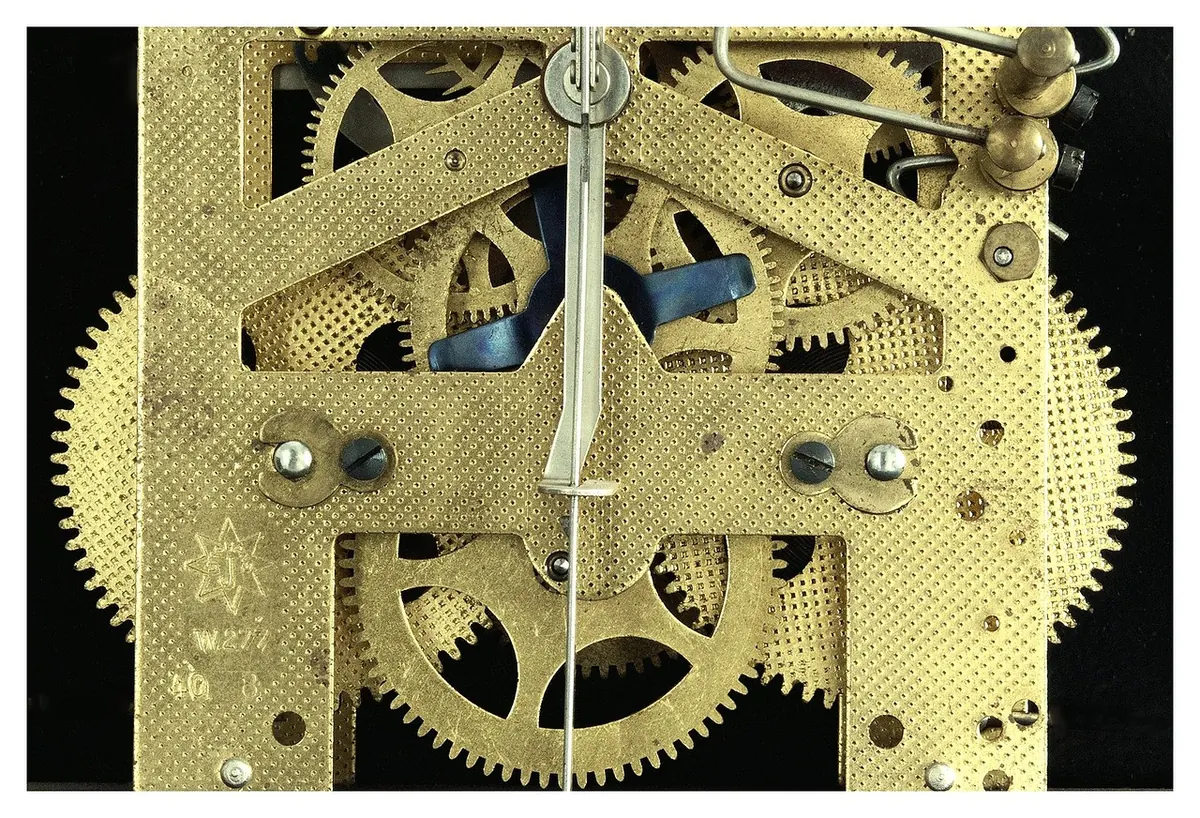
The clock stage reads differently. A dial needs an uninterrupted wall plane, so you often find a reinforced lintel, an iron bearing frame, or a shallow recess built to carry the dial and its arbor. The clock room behind can be surprisingly small, sometimes squeezed into a corner of the bell chamber, sometimes on the floor below.
What each element loads onto the structure
Swinging bells are a dynamic load. A bell in full swing pushes and pulls on its bearings, and the frame transmits that oscillation into the masonry. Crown staples, headstocks, bearing plates and frame bolts all take cyclical stress, which is why bell fittings are inspected far more often than the walls around them. The clock is a light load by comparison, but a concentrated one, and its driving weights travel several metres down a shaft. A weight that comes adrift is small and heavy, and there is rarely anything soft in its path.
When the Clock Moves In
Most historic towers were built without a clock. Installation, whether in the sixteenth century or the twentieth, followed a similar pattern: choose the wall facing the market, cut an opening for the dial, create a clock room, fix a bearing frame, and run a train of rods and gears up to the dial and down to the weights. Electrification later added cabling, dial illumination and, often, an electric motor bolted to an older movement. Quartz and radio-controlled units followed.
Each of those steps left a mark: blocked shafts, cut joists, iron brackets rusting inside damp masonry, redundant rods still hanging in the dark. The clock is frequently the least documented and most altered element in the whole tower, which matters when someone proposes removing it because it "isn't original".
Why the Distinction Changes Maintenance
The two systems need different trades and different rhythms. Bells call for a bell hanger or founder: clapper wear, crown staple condition, bearing clearance, frame tightness, rope or motor drives. Clocks call for a horologist: winding, lubrication, regulation, hand alignment, dial glazing. Neither specialist is usually qualified to pronounce on the other's equipment, and a report that treats the tower as one machine tends to be thin somewhere.
What they share is the building. Water almost always enters at the louvres or around the dial bed, and it lands on both mechanisms. Access is the same ladder, the same hatch, the same rotten floorboard.
A short annual walk-round
- Trace water. Look at the backs of the louvres and the joint between dial and masonry after heavy rain.
- Look up the weight shaft with a torch, and clear anything that has fallen into it.
- Check bell frame bolts and bearing plates for bright wear marks or movement dust.
- Photograph the dial, hands and clock room each year; a dated series is the cheapest condition record you will ever make.
- Confirm lightning protection continuity after any work on the roof or the frame.
- Note who holds the keys, and write down the winding or servicing dates in the tower, not only in an office.
Heritage: Deciding What You Are Conserving
Significance is rarely spread evenly through a tower. A fourteenth-century bell frame, an 1890s turret clock, a 1950s repainted dial and a 2004 electric drive can sit in the same room, and the newest item is not automatically the disposable one. Assess each element on its own: what it is, when it arrived, how much of it survives, and whether it still does its job.
Two habits save a great deal of regret. First, record before you alter: measured drawings, photographs, and a note of every fixing hole. Second, when machinery becomes redundant, leave it in place if it can safely stay. A disconnected movement on its original frame tells the tower's story better than an empty room. On listed buildings, and in Italy on any tower of historic interest, structural and mechanical changes normally need authorisation from the heritage authority; check before work starts rather than after scaffolding goes up.
A Practical Way to Decide
Before commissioning anything, separate the two systems on paper. Ask for one condition report on the bells and their frame, and another on the clock and dial, each from someone who works on that equipment regularly. Then look at the building as the thing they share: roof, louvres, floors, access, lightning protection. Sequence the work so scaffolding is erected once, and so the clock specialist is not standing on a platform the bell hanger needs. Keep the paperwork in the tower as well as the office. A tower that does two jobs deserves a maintenance plan that admits it.
Photo: Sammy-Sander / Pixabay