A Beginner's Guide to Tower Clock Movements: Weight-Driven, Spring-Driven, and Electric
Climbing into a tower clock chamber is a little like opening a mechanical diary. Ropes, rods, levers, and a pendulum tell you how the clock was built, how often someone had to wind it, and what has been changed since. For a beginner, the quickest way to make sense of that diary is to identify the movement type. Almost every historic tower clock falls into one of three families: weight-driven, spring-driven, or electric. Each solves the same problem — storing energy, releasing it at a steady rate, and showing the time — in a different way.
The Basic Job of Any Tower Clock Movement
Every movement has a power source, a going train, and a controller. The power source may be a falling weight, a coiled spring, or an electric motor. The going train is the sequence of wheels and pinions that carries that power up to the hands. The controller is the escapement and oscillator — usually a pendulum in a tower — that releases the train in equal steps. A striking or chiming train may sit alongside the going train, often with its own power source. When you understand those three parts, you can compare movements without getting lost in the detail.
The differences matter in practice. They affect how often the clock needs attention, how much space it occupies, what spare parts look like, and how carefully a repair should be approached. A weight-driven clock is not simply an old version of an electric one; it has its own logic, its own sound, and its own maintenance rhythm.
Weight-Driven Movements: Gravity Does the Work
Weight-driven tower clocks are the classic image of horology: a heavy weight hanging on a rope, chain, or cable, slowly descending through the tower. The weight turns a drum or barrel, which drives the going train. In many English and European towers the going train has its own weight, the striking train has another, and a chiming train may have a third. A clock that runs for thirty hours will need winding every day; an eight-day movement needs winding weekly. Some larger or more elaborate clocks run for a month or longer, but the principle is the same: the available fall of the weight sets the power reserve.
The beauty of a weight is that it delivers a nearly constant force. As long as the weight is free to fall and the rope or chain is in good condition, the drive is remarkably steady. The weak points are mechanical: rope fraying, chain wear, cable stretch, corroded pulleys, and dirt in the barrels. A weight-driven clock also needs enough height. If a weight cannot fall its full distance, the clock will stop early, and a well-meaning attempt to add more weight can overload the movement.
Regulation is usually by a pendulum, often a seconds pendulum about one metre long, with an escapement at the top. The escapement may be an anchor, a deadbeat, or a pinwheel; some fine tower clocks use a gravity escapement, which isolates the pendulum from the changing force of the train. That detail is worth noticing because it tells you how much of the clock's accuracy depends on the escapement and how much on the pendulum.
Spring-Driven Movements: Compact Power, More Temperament
Spring-driven movements use a coiled mainspring inside a barrel. They are common in smaller tower clocks, in clocks fitted into tight chambers, and in movements that were made as reliable alternatives to weights. The spring stores energy in a small space, so the clock does not need a long vertical drop. That makes installation easier, but it introduces a characteristic problem: a mainspring's force changes as it unwinds. Early and better-made spring clocks use a fusee — a spiral pulley that equalises the pull — or a maintaining power system that keeps the train driven while the clock is being wound.
Spring-driven tower clocks often have shorter power reserves than weight-driven ones, and they can be more sensitive to a tired spring, a dry pivot, or a worn barrel arbor. Winding is usually by a crank or key, sometimes from a lower floor through a rod or endless rope. The regulator may still be a pendulum, but you may also find a balance or a more compact escapement in smaller examples. When a spring clock is running poorly, the answer is not automatically "a stronger spring"; the train, escapement, and lubrication need to be assessed together.
Electric Movements: Motors, Impulses, and Master Clocks
Electric tower clocks are a broad family, and the label can mislead. Some are simply weight-driven clocks with an electric motor that winds the weights automatically. The original going train, pendulum, and escapement remain, but the winding chore disappears. Others are motor-driven: an electric motor turns the hands through a gearbox, and a controller decides when to run. A third pattern is the impulse or slave system, where a master clock sends pulses to a movement in the tower, or to a set of dials, and the tower movement follows the master.
Regulation depends on the system. A master clock may use a pendulum, a quartz oscillator, or a signal from a time source; a motor-driven clock may rely on a quartz controller or on mains frequency; an impulse dial may simply count pulses. Electric systems bring their own maintenance points: contacts can pit, batteries can leak, controllers can lose their settings, and motors can suffer from worn brushes or failing capacitors. They also make retrofits tempting. A twentieth-century electric unit may sit inside an eighteenth-century frame, and the historian's question is not only "Does it work?" but "What is original, what is reversible, and what has been removed?"
How to Tell What You Are Looking At
Start with a slow visual survey before touching anything. The clues are usually obvious once you know what to look for.
- Look for weights: hanging boxes, stone-filled tubes, or iron castings on ropes, chains, or cables point to a weight-driven movement, even if a motor now winds it.
- Look for springs: barrels with ratchets, winding squares, and fusee cones suggest spring power; a crank point low in the case may be a winding point.
- Look for wires: low-voltage cables, contact blocks, and a control box indicate an electric or hybrid system.
- Listen and watch: a steady pendulum tick with a heavy, slow release is typical of a weight clock; a motor that runs in bursts suggests electric winding or drive.
- Read the plates: maker's names, dates, and repair inscriptions can confirm the original type and later changes.
Take photographs before you adjust anything, and note which parts move together. A simple sketch of the train and the power source will save hours later.
A Sensible Approach to Care and Repair
Treat a tower clock as a piece of working heritage, not a domestic appliance. Isolate the power before you inspect the movement: let weights down safely, restrain springs with the proper tool, and switch off and lock off electric supplies. Do not oil indiscriminately; old oil mixed with dust becomes an abrasive paste, and some modern lubricants are unsuitable for brass and steel in an unheated tower. Keep any replacement part reversible, and keep the original part labelled and stored.
For anything beyond cleaning and observation, call in a clockmaker who has tower experience. The work is heavy, the access is awkward, and the consequences of a dropped weight or a released spring are serious. A sensible routine is simple: check the power source, listen to the beat, look for wear and dirt, record what you see, and plan maintenance before something fails. That habit will serve you well whether the clock in front of you is a Georgian weight-driven movement, a compact spring clock, or a quiet electric retrofit.
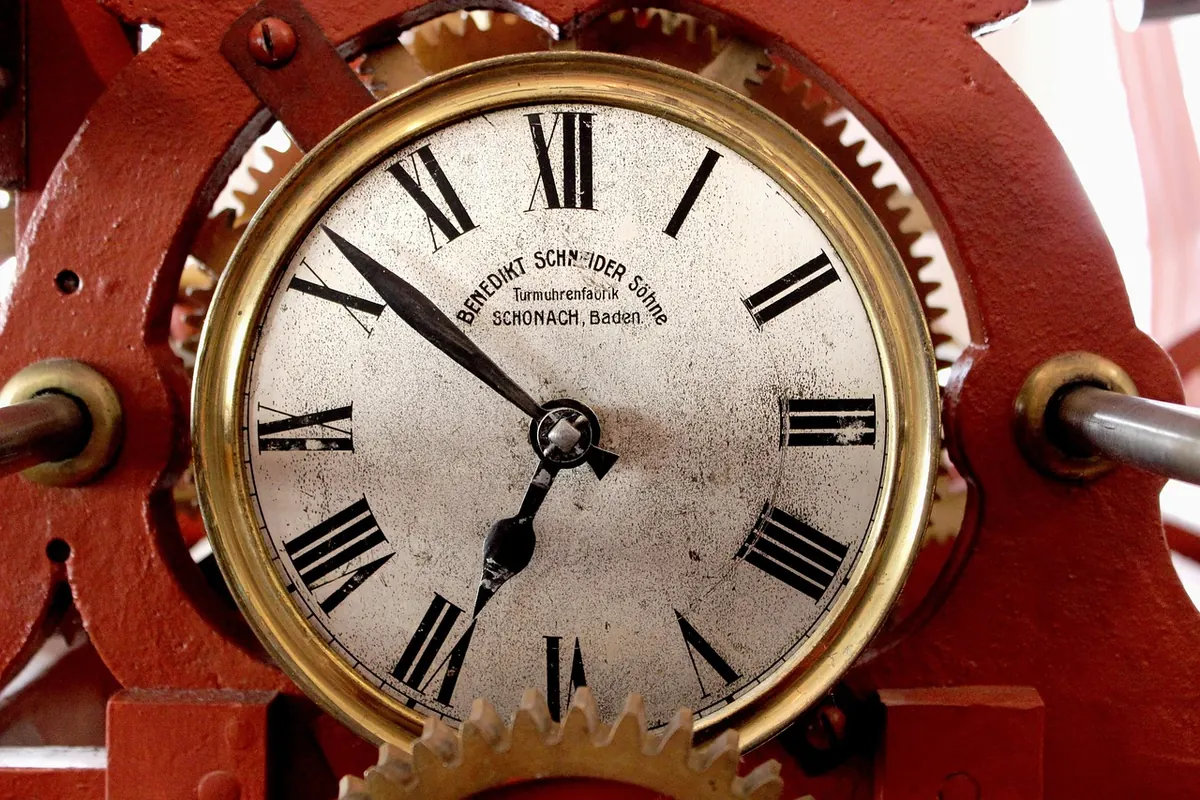
Photo: khfalk / Pixabay